

Economic growth, downtown revitalization and regional collaboration headline discussion with the business community.
Por Ana Paula Kiyama | EL PASO, Texas —
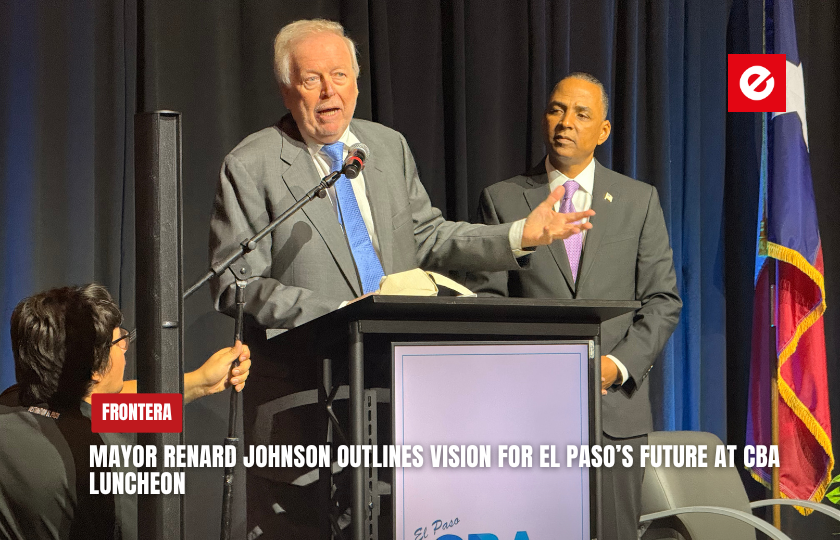
Before a room filled with business leaders, developers and community stakeholders, El Paso Mayor Renard Johnson delivered a clear message at the Central Business Association’s July luncheon: the city’s future depends on attracting high-value industries, strengthening regional partnerships and creating opportunities that encourage young talent to build their careers in El Paso.
Moderated by Central Business Association President and CEO Tanny Berg, the conversation moved beyond politics and into the issues shaping the region’s economic future. Berg guided the discussion through topics including tax policy, workforce development, downtown revitalization, infrastructure, public safety and regional collaboration, challenging the mayor on the priorities that matter most to El Paso’s business community.
Growing the Commercial Tax Base
One of the first topics addressed was the city’s tax structure.
Berg noted that residential property owners continue to shoulder most of the tax burden and asked how the city plans to expand its commercial tax base to provide relief for homeowners.
Johnson pointed to Meta, which is expected to become the city’s largest taxpayer, as an example of the type of investment El Paso must continue attracting.
“We need more companies to come into town to start lowering our residential property tax,” Johnson said.
However, he emphasized that economic development must remain balanced with responsible resource management.
“We have to safeguard our water, our utilities and our climate while continuing to recruit industries that strengthen our tax base.”
The mayor also acknowledged that the city faces significant financial challenges, including reductions in federal grants and changes to Texas’ business personal property tax exemption, which he said removed approximately $8 million from the city’s budget.
Despite those headwinds, Johnson reaffirmed his administration’s commitment to maintaining fiscal responsibility while continuing to pursue economic growth.
Creating Careers, Not Just Jobs
For Berg, attracting companies is only part of the equation. He emphasized that El Paso must recruit employers capable of creating careers with salaries that allow young professionals to remain in the region instead of relocating elsewhere. Johnson agreed.
“We have to provide opportunities for our youth to stay home,” he said. “Anyone born here, educated here and raised here should be able to find a great job here.”
He added that the city is already in discussions with additional industries offering significantly higher wages than many traditional employers.
Downtown: The Front Door of the Region
Perhaps the most extensive conversation centered on downtown El Paso. Berg asked what steps the administration is taking to revitalize downtown while preserving its history, supporting local businesses and encouraging shoppers from Ciudad Juárez to return. Johnson described downtown as far more than a business district.
“Downtown is the front door to your community,” he said.
Rather than viewing El Paso as a city of roughly 800,000 residents, Johnson encouraged thinking of the Borderplex as a 2.7 million-person region stretching from Las Cruces to Ciudad Juárez. He pointed to the success of WinterFest, which attracts approximately 600,000 visitors over six weeks, as evidence that downtown has become an important regional destination. But he also argued that El Paso has outgrown some of its public spaces.
“I think we’re at a point where we have to start looking at expanding downtown so we can host events of that magnitude.”
Johnson also acknowledged the lasting impact Interstate 10 had on historically diverse neighborhoods, saying future redevelopment should reconnect communities while creating more green space and public gathering areas—an amenity he said younger generations consistently request.
Regional Collaboration Drives Competitiveness
Another recurring theme throughout the luncheon was collaboration. Berg asked how partnerships with neighboring communities could strengthen the Borderplex economy. Johnson pointed to Fort Bliss, Ciudad Juárez, Las Cruces and surrounding municipalities as essential economic partners rather than competitors.
“Fort Bliss puts more than $24 billion into the El Paso economy every year,” he said.
He also highlighted the more than $120 billion in annual trade crossing the southern border and stressed that continued coordination with neighboring governments is critical to maintaining economic momentum.
Among current initiatives, Johnson cited recent joint meetings between the El Paso and Ciudad Juárez city councils, collaboration between economic development teams and ongoing efforts to expand air service, including proposed direct flights to Chihuahua, New York, Washington, D.C. and San Francisco.
Berg also suggested exploring the return of an international streetcar connection between downtown El Paso and downtown Juárez, saying it could become another catalyst for economic activity on both sides of the border. Johnson welcomed the suggestion, joking that it would be added to his growing list of priorities.
Public Safety Remains the Foundation
Economic development cannot exist without public safety, Johnson said. He reaffirmed that supporting police officers, firefighters and first responders remains one of his administration’s highest priorities. The mayor highlighted improvements in staffing, noting that police and fire academies have returned to pre-pandemic enrollment levels. He also pointed to recent federal grants that funded additional police officers and firefighters without increasing costs for local taxpayers.
“Our city remains one of the safest in America,” Johnson said. “We’re committed to keeping it that way.”
Looking Toward the Future
Berg concluded the luncheon with a question he said he asks every mayor who addresses the Central Business Association:
If the business community gathers again four years from now, what accomplishments would define your administration, and what legacy do you hope to leave for future generations?
Johnson’s response focused less on individual projects and more on long-term opportunity. He said he hopes residents will remember an administration that strengthened El Paso’s economy, invested in infrastructure, expanded opportunity for future generations and created an environment where young people can build successful careers without leaving their hometown.
“I want El Paso to be a place where if you’re born here, you can stay here, build your future here and succeed here.”
As the luncheon concluded, the discussion reflected a shared vision between the city’s leadership and the business community: El Paso’s future will depend not only on attracting investment, but on building a stronger regional economy through collaboration, innovation and strategic leadership.
